
|
Share to:
Related Products


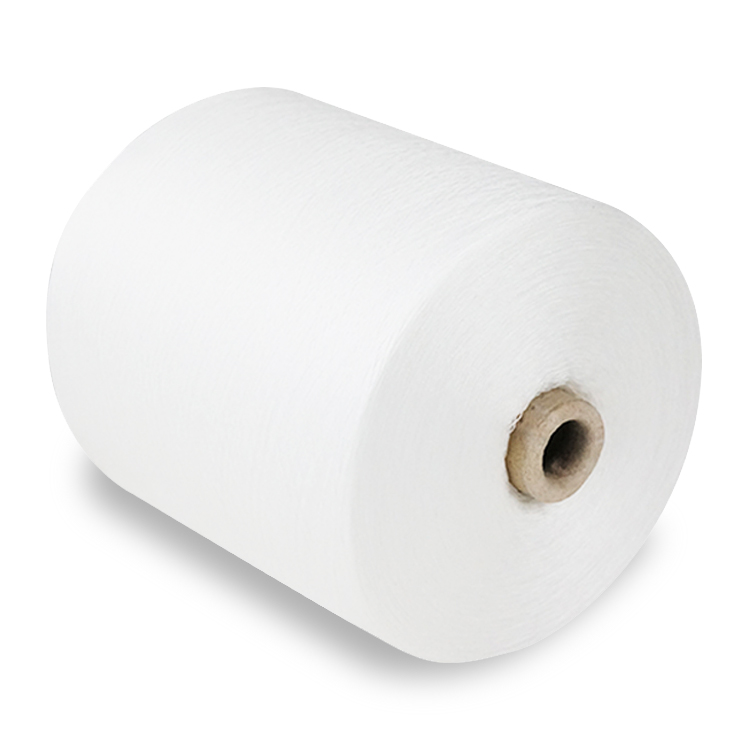
Hot sale dope dyed polyester poy 100% polyester yarn
LQ-0412
Price: From $0.66
Delivery time: 9-20 days after payment
MOQ: 500KG
Hot sale dope dyed polyester poy 100% polyester yarn
Common quality problems of cheese dyeing, internal and external color difference
The most common quality problem of cheese dyeing is the color difference between inside and outside. Regardless of the fiber quality, the main reason for the color difference is the insufficient dye flow. It can be analyzed from the following 12 directions.
1. Insufficient flow of main pump
The essence of the color difference is that the amount of dye dyed on the yarn is different. Here we can imagine a special case: if the main pump is not turned on when the cheese is dyed, that is to say, it is equivalent to immersing the cheese in a static dyeing bath, then the color of the inner and outer layers of the cheese contacting with the dye will appear, and the color will be lighter when it is closer to the middle, and the central part may still be the natural color. This is similar to the phenomenon of "white core" caused by belt slippage in axial-flow pump dyeing machines in 1970s due to insufficient pump speed or not being noticed after pump stop. Obviously, at this time, the dye solution does not contact with the yarn in the middle layer of the package. Although the inner yarn is wet due to capillary action, the dye has been absorbed by the yarn contacted first due to the adsorption of the yarn along the way, so there is no dye on the middle layer yarn.

It can be seen from the above that there is no forced circulation of the main pump, resulting in the color difference between the inside and outside of the cheese is inevitable.
According to the theoretical model analysis of cheese dyeing, there is an obvious characteristic of cheese dyeing, that is, the dye concentration will decrease along the process (DC / DX, concentration difference along the way) in the process of dyeing liquor circulating in the cheese yarn. Only when the circulation speed of dye solution is large enough to make the dye adsorbed and diluted, so that the concentration of dye solution contacted by the yarn inside, outside and inside is consistent, the color difference along the package will not appear.
That is to say, in order to prevent the color difference between inside and outside, the main pump must provide enough flow speed flow rate of dye liquor. Therefore, combined with other factors, the specific flow rate, cycle frequency and so on mentioned in Chapter 5 are obtained. Theory and practice have proved that: as long as the flow rate is enough, even if only positive circulation, can also be leveled, so that the satisfactory effect of no color difference can be achieved (in fact, due to the different streamline density of dye liquor in the inner, middle and outer ring, there will be inner middle outer color difference.
2. Insufficient effective flow
The main pump flow is not equal to the actual flow through the yarn layer (effective flow), and the ratio of the two is the effective flow rate (effective flow rate = effective flow rate / actual flow rate of main pump). The reason for the difference between the two flow rates is that part of the flow rate is leaking, such as the poor sealing between the bobbins. As mentioned above, the effective flow rate of different bobbins ranges from 60% to 90%. Nearly half of the flow rate of the stainless steel conical tube main pump sealed with spacer is invalid. In addition, due to some reasons, the "open eyes" or "broken belly" will lead to "short circuit" of dye liquor, which will significantly reduce the effective flow rate.
3. Insufficient head of main pump

The head of the main pump is used to overcome all kinds of resistance (along the way resistance, local resistance, yarn filtration resistance, etc.) when the system resistance is large, but the main pump head is insufficient, it will cause problems. From the H-Q characteristic curve of the pump, it can be seen that although the dyeing solution will not be out of circulation, with the increase of H, the working point will be transferred, and the flow will become smaller, which will cause the inner middle outer color difference.
4. The winding density is too high and the package layer is too thick
As is known to all, loose cheese is needed for cheese dyeing, which is not only uniform in density, but also less dense than conventional cheese. No matter what the winding density of the dyeing drum is, there will be "filtration resistance" when dyeing. If the density is high, the resistance is large, otherwise the resistance is small. The resistance of the filter system will be changed due to the change of the resistance curve of the main pump. Therefore, the winding density of the bobbin should be matched with that of the dyeing machine. When the pump capacity is not too abundant, the winding density should be smaller.
If the yarn layer on the bobbin is too thick (too much yarn), the filtration resistance will also increase. It is generally considered that the thickness of the yarn layer should not exceed 50 mm.
5. Forward and reverse circulation arrangement
From the inner layer to the outer layer, the radius of the cheese increases gradually, and the yarn capacity of each layer also increases, but the effective flow rate of the main pump does not increase on each layer. In other words, the dye flow through the yarn layer at different radii is the same. When the dye liquor circulates from the inside to the outside, the area of the yarn increases gradually, and the dye solution per unit area increases with the increase of the radius. The density of streamline decreases. Although the velocity of the fluid is large enough to make up for the decrease of the concentration along the way, the problem of deep inside and shallow outside will also occur due to less material and more yarn.
When the dye liquor is in reverse circulation (from the outside to the inside), the streamline density of the dye along the flow direction becomes more and more, and the situation becomes that there are more materials (dyed) and less yarn, and the dye concentration along the process is reduced, which is conducive to reducing the inner, middle and outer color difference.
Therefore, a certain amount of reverse circulation time should be considered for dyeing machines with insufficient main pump capacity. As a result, some people designed the reverse circulation time to be longer than the positive cycle.
But the author is not in favor of frequent reversing, especially for some dyeing machines with slow reversing. Because commutation will reduce the dye circulation time, and some will cause yarn hairiness, felting and other problems.
7. The change of package density causes the color difference between inside and outside
The swelling degree of different fibers is different in the process of yarn dyeing. For example, in water, the diameter of cotton fiber increases by 20%, wool diameter increases by 15%, viscose fiber diameter increases by more than 35%, and Tencel diameter increases more. As the winder is dry yarn, the increase of diameter in water makes the yarn coarser, while the length increases slightly (1% - 2%), which makes the winding density increase. Swelling is more serious in alkali solution. In hot water, the length of synthetic fiber shrinks and the density of the package increases. Some elastic yarns (such as spandex core spun yarn and wrapped yarn) will shrink violently under hot and humid conditions. All of these will destroy the original bobbins which have been wound evenly. On the one hand, the density will increase, on the other hand, it will become uneven.
As mentioned above, with the increase of package density, the filtration resistance will be increased, resulting in the decrease of dye flow rate and the aggravation of color difference between inside and outside.
8. Influence of tube diameter and penetration rate
All the data and a lot of practice show that the large diameter of the bobbin is conducive to level dyeing, and the high penetration rate is conducive to leveling
(1) If the diameter of the bobbin is large, the layer of the winding yarn will be thin if the diameter of the bobbin is large. Because of the thin yarn layer, the filtration resistance of dye liquor penetrating circulation is small, and the flow rate is large, so the color difference between inside and outside is small.
In addition, the thinner the yarn layer, the smaller the difference of winding diameter between the inner and outer layers of yarn, the smaller the difference of streamline density, and the smaller the color difference between inside and outside. The thinner the yarn layer is, the shorter the dye penetration time is, the smaller the dye degree difference along the way, and the smaller the inner middle outer color difference.
(2) High penetration rate and low resistance of the bobbin: the bobbin is full of holes, and the dye solution can be redistributed to the inner layer of the yarn only after passing through these holes. For dye solution, these holes form local resistance, which is part of the system resistance. If the penetration rate is high, the resistance will be small, otherwise, the flow rate will decrease, which will lead to the color difference between inside and outside.
9. Effect of dyeing and chemical properties and dyeing process
The dye uptake rate (especially the initial dyeing rate) and transfer rate will be affected by the nature of the dyestuff and the setting of dyeing process parameters. When the dye uptake rate is too fast and the transfer rate is low, uneven dyeing will be caused, that is, the inner middle outer color difference.
10. Influence of improper use of post dyeing softener
Generally, the yarn will be astringent and hairy after dyeing, which makes the subsequent process difficult, especially the dark color. For this reason, many manufacturers have increased the "oiling" process, which is generally treated with smooth surfactant, and some with silicone. However, due to the low refractive index of silicone, there will be a "darkening" effect. If the "oiling" is uneven, that is, the darkening is uneven, it will also cause the internal, middle and outer color difference.
11. Water quality impact
When the cheese is dyed, the yarn on the package acts like a filter material. In the whole process of dyeing, pretreatment, dyeing, soaping and cleaning solution were filtered through thousands of times. When the water quality is poor and the impurity content is too high, rust and dirt exist in the pipeline equipment, or in the pretreatment, some impurities are deposited on the yarn due to uneven dispersion of cellulose symbionts in the pretreatment solution, resulting in yellowing of the inner layer (also yellowish brown). Rust (Fe2 +, Fe3 +) can be removed by oxalic acid and acetic acid treatment. Therefore, water should be used to clean the equipment.
12. Uneven winding density of bobbin
When the bobbin is wound, the radial density distribution is not uniform, and the inner layer is too loose, so that the axial flow rate of dye liquor increases, resulting in the inner depth and outer shallow.
Therefore, in the polyester yarn dyeing process to try to control each link. Avoid color problems.